Car rental software
Car rental software in Morocco: custom-built or off-the-shelf?
Ready-made software is faster to start with, custom software fits your agency exactly. Here is how to choose, with the Moroccan details (invoices, languages, contracts) that generic tools often miss.
By Zakaria Bijaddigune, freelance full-stack developer in Agadir
· 7 min read
For most car rental agencies in Morocco, ready-made software is the right place to start, as long as it handles Moroccan invoices (ICE, IF, RIB, taxe professionnelle, amounts in MAD), works in French and Arabic, and lets customers sign contracts without a printed form. Custom software makes sense when your agency runs in a way no product supports, or when the software itself is part of your competitive edge.
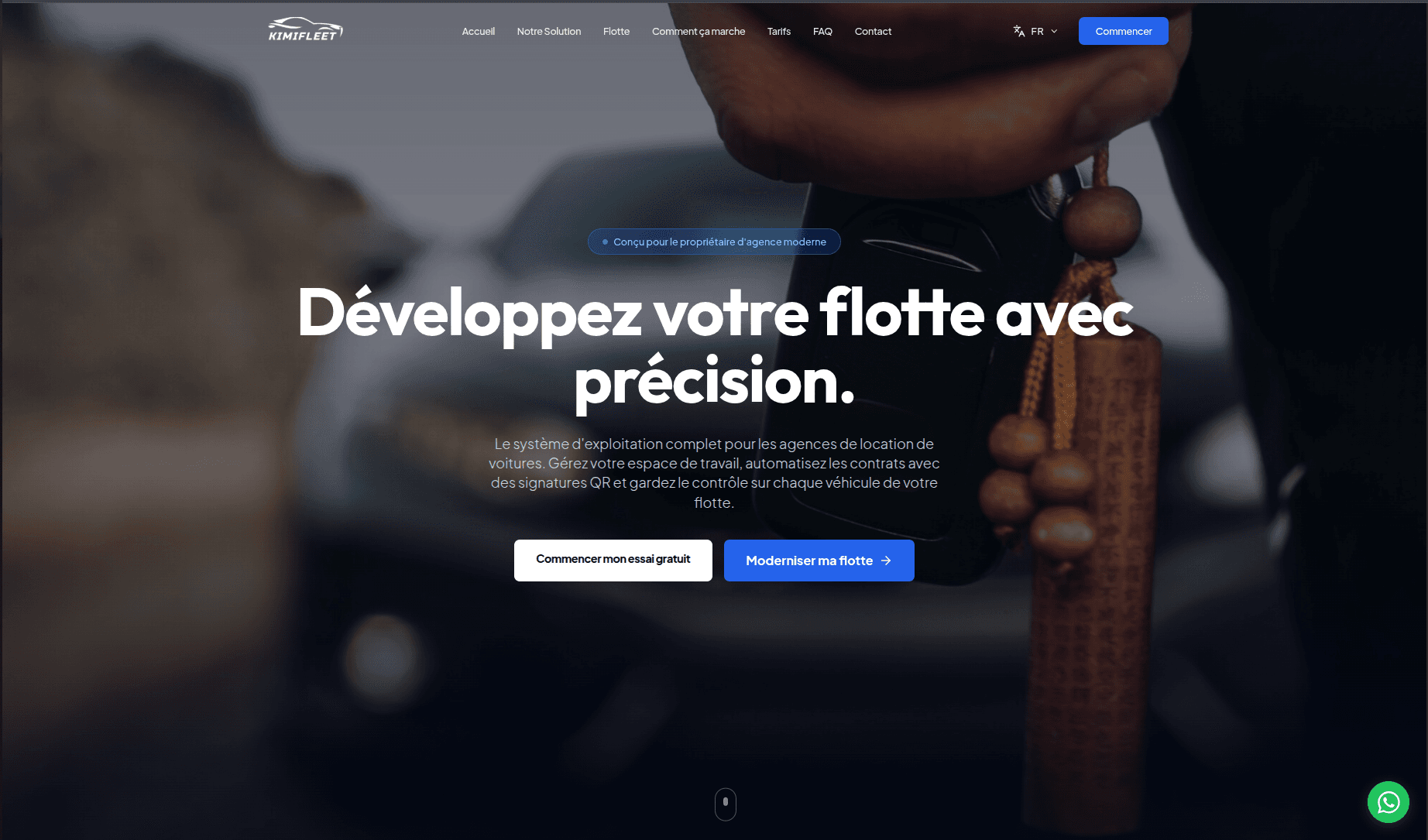
I’m Zakaria, a freelance full-stack developer in Agadir. I built KimiFleet, a car rental management SaaS designed around how Moroccan agencies work, and I also build custom fleet software for companies with specific needs. This article explains the trade-offs as I see them from both sides.
How many agencies still work today
A lot of rental agencies in Morocco still work with spreadsheets, paper contracts and a phone full of WhatsApp conversations. It works until it doesn’t. The same problems come up again and again:
- Nobody knows for sure whether a given car is making money once maintenance is counted.
- A customer who isn’t at the agency can’t sign the contract, so the handover waits.
- Two employees take bookings for the same car on overlapping dates because the spreadsheet wasn’t updated.
- Invoices are typed by hand, and the tax identifiers are sometimes missing or wrong.
- The owner has to be present, or on the phone, for every decision because the information lives in one person’s head.
Software fixes these problems by putting every car, booking, customer and invoice in one shared place. The question is which kind of software.
What any car rental system needs
I’ll write a separate article on features in detail. In short, whatever you choose should cover the basics:
- A fleet list with the real status of each car (available, reserved, rented, in maintenance, out of service).
- Bookings that block overlapping dates automatically.
- Contracts and invoices generated from the booking, not typed again.
- Payments tracked per rental, including partial payments.
- Accounts for each employee, with limits on what each one can see or change.
If a product can’t do these well, it doesn’t matter how good the rest is.
Off-the-shelf software: pros and cons
Off-the-shelf means a product you subscribe to and start using: you sign up, add your cars and begin.
The advantages are real:
- You can start quickly, with no development project to manage.
- Someone else maintains the servers, the backups and the updates.
- The cost is a predictable subscription instead of an upfront project.
- Many common problems are already solved because other agencies use the same product.
The drawbacks show up when the product wasn’t made for your market:
- A product built for another market may produce invoices without Moroccan tax fields, or may not fit on currency or language.
- You adapt your way of working to the software, not the other way around.
- If you need a feature the product doesn’t have, you can ask, but you can’t make it happen.
- Your data lives in someone else’s system, so check that you can export it.
Custom software: pros and cons
Custom means a developer builds a system for your agency alone, and you own it.
The advantages:
- It follows your exact process: your contract layout, your pricing rules, your approval steps.
- It can connect to the tools you already use, such as accounting software or an ERP.
- It can include features no product offers, for example a driver app or vehicle tracking.
- You own the code and the data, and you decide what gets built next.
The drawbacks:
- There is an upfront cost and a development period before you can use it.
- You need someone to host, maintain and update it after launch.
- A badly scoped project can end up rebuilding features that a ready-made product already does well.
Custom is a strong choice for operations that go beyond plain rental. I worked on a fleet and cold-chain logistics platform for a Moroccan food distributor: a driver app with QR-code vehicle check-in, live temperature alerts, fuel tracking and automatic maintenance recommendations. No rental product would cover that, so building it was the only sensible option.
Moroccan details that matter
Whichever route you choose, check these points carefully. They are where generic software most often falls short.
Invoices with the right identifiers
A Moroccan invoice needs your ICE, IF, RIB and taxe professionnelle number, with amounts in dirhams. If you have to add these by hand every time, the software isn’t saving you much. In KimiFleet, invoices come out as print-ready A4 documents with these fields already filled in.
French and Arabic
Your staff may prefer French, some customers will be more comfortable in Arabic, and tourists will want English. Good software lets each user pick a language, and Arabic should display right to left properly, not just as translated text.
Signing the contract on the customer’s phone
Customers often arrange a rental before they reach the agency. Being able to send a signing link that opens on the customer’s own phone saves time at handover and removes the paper. In KimiFleet, the agent creates a short-lived signing session, the customer signs on their phone with a finger or stylus, and the signature is added to the contract automatically, without paying for a separate e-signature service.
For many agencies, a booking starts with a WhatsApp message. Your software doesn’t need to replace WhatsApp, but it should make it easy to move a conversation into a proper booking and to send links (a booking page, a contract to sign) that customers can open from the chat.
Side by side
| Question | Off-the-shelf | Custom-built |
|---|---|---|
| Time before you can use it | Short, you sign up and start | Longer, there is a development period |
| How you pay | Subscription | Upfront project, then maintenance |
| Fit with your process | You adapt to the software | The software adapts to you |
| Moroccan invoices and languages | Depends on the product, check carefully | Built in from the start |
| New features | You ask the vendor | You decide and pay for them |
| Hosting and maintenance | Handled by the vendor | You or your developer |
| Ownership of the code | The vendor | You |
| Links to other systems (ERP, tracking) | Limited to what the product offers | Built to your needs |
How to decide
Go through this checklist honestly:
- Write down how a rental moves through your agency today, from first message to returned car. If it looks like most agencies, start with a ready-made product.
- Check whether the product produces invoices with ICE, IF, RIB and taxe professionnelle in MAD. If not, keep looking.
- Ask whether your staff and customers can use it in French and Arabic.
- Test contract signing with a real customer phone, not only on the office computer.
- Check that you can export your data at any time.
- List what you would still do outside the software. If that list is long and specific to your business (refrigerated trucks, delivery missions, an ERP), custom is worth discussing.
- Think about the next few years. If software is central to how you plan to grow, owning it may matter more than starting fast.
On cost: a custom project depends on the number of user roles, the screens and documents you need, the integrations, and whether you need a mobile app. I don’t quote prices in advance; after a short call to understand the scope, I give a fixed quote.
Where KimiFleet fits
KimiFleet sits between the two options. It is ready-made software, so you subscribe and start, but it was built specifically for Moroccan rental agencies rather than adapted from a foreign product.
What it does today:
- Fleet status, an availability calendar and bookings that block conflicting dates.
- Contracts signed on the customer’s own phone.
- Invoices in MAD with ICE, IF, RIB and taxe professionnelle, with full or partial payment tracking.
- Profit per car: rental income minus logged maintenance costs.
- Staff accounts with permissions per area (fleet, customers, rentals, invoices, maintenance, team, settings).
- A public booking page for each agency on its own subdomain.
- French, Arabic and English, on the web dashboard and the mobile app.
To be transparent: KimiFleet is live and fully working at kimifleet.com, but no agency has signed up yet. I built it alone over about four months, and I would value feedback from agency owners. You can read the KimiFleet case study or the French page about the software.
If KimiFleet covers most of what you need but not everything, that is worth a conversation too. Sometimes the best answer is a ready-made base plus a few changes, rather than a full custom build.
Next step
If you run a rental agency or a fleet and aren’t sure which route fits, describe how your agency works today and I’ll tell you honestly whether KimiFleet, another ready-made product or a custom system makes the most sense.