Khydmati: Full Stack & Mobile Marketplace
A reverse-marketplace for home cleaning in Morocco, with ID-verified providers.
- Role
- Freelance, full stack
- Status
- Live
- Sector
- Home cleaning marketplace
The problem
Home cleaning in Morocco mostly runs on word-of-mouth: no shared pricing, no way to check who you're letting into your home, and no record if something goes wrong. Householders either overpay out of caution or take a chance on someone unverified, and cleaners have no structured way to find work beyond their existing network.
What I built
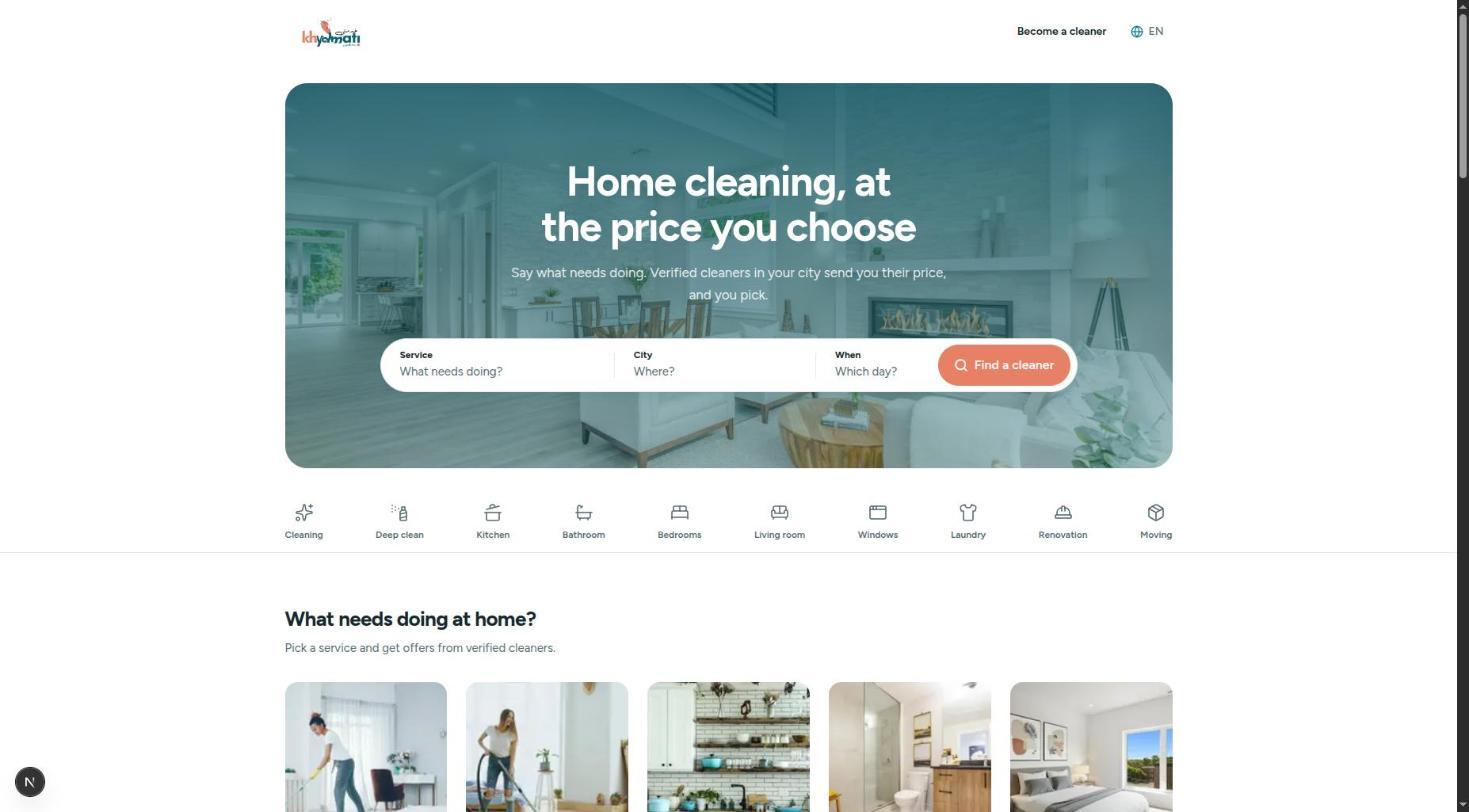
Khydmati flips the usual booking flow: instead of fixed listings, a householder describes the job (service, city, day) and verified cleaners in that city send their own price. The householder compares offers and picks one, the job becomes a tracked deal, and the platform takes a commission on completion. An admin team moderates cleaner verification, bookings, and payouts through a dedicated ops dashboard.
Key features
- Demand → Proposal → Deal lifecycle
- A householder posts a demand (service type, property, date, time slot). Cleaners browse open demands in their city and submit a priced proposal with a note. An accepted proposal becomes a deal with status tracking through to completion, review, and optional dispute.
- KYC & trust
- Before a cleaner can send an offer, they pass a Didit verification flow: ID-card photo (front and back) checked for authenticity, a live selfie matched against the ID, then a manual review step. Verification status (pending/approved/rejected) is visible to the cleaner and enforced by the API, not just the UI.
- Wallet & commissions
- Each cleaner has a running wallet balance; completed jobs generate a commission owed to the platform, visible to both the cleaner (mobile) and ops team (dashboard), with per-cleaner commission payment tracking.
- Admin operations console
- A Material UI dashboard (adapted from a commercial admin template) for the ops side of the business: approving/suspending cleaners, resolving verifications, monitoring bookings and invoices, and a financials view separate from the per-booking invoice list.
- Messaging & notifications
- In-app 1:1 chat opens once a proposal is accepted, with push notifications for new offers, messages, and booking status changes.
- Localization
- French, English, and Arabic across both the mobile app and admin dashboard, with Arabic driving a full RTL layout flip (`I18nManager.forceRTL` on mobile, `stylis-plugin-rtl` on the dashboard) rather than just mirrored text.
Architecture
- Backend: NestJS + Prisma + PostgreSQL, with separate route namespaces for the mobile API and the admin/dashboard API behind the same service layer, plus a dedicated analytics/overview module for dashboard KPIs.
- Mobile: Expo (React Native 0.81, React 19) with a hand-rolled theme system (colors/typography/spacing tokens) rather than a component library, Zustand for auth/city/service state, and React Navigation with role-based stacks (householder vs. cleaner) chosen once at onboarding.
- Admin dashboard: Vite + React 18 + MUI, built on top of the Able Pro admin template and reworked around the platform's own domain modules (bookings, cleaners, households, invoices, financials, verifications) instead of the template's generic CRM screens.
- Public site: Next.js 16 with next-intl for localization and Radix UI primitives for the booking search and service picker.
- Auth: JWT access/refresh tokens; phone-based sign-in through Twilio Verify (SMS or WhatsApp channel) rather than email, matching how the target market actually communicates.
Decisions and trade-offs
- Reverse pricing over fixed listings: cleaning rates vary a lot by job size, access, and city in Morocco, so a single posted rate per cleaner doesn't fit well. Letting cleaners price each job individually, and householders compare offers, pushed the pricing problem onto the market instead of a rigid rate card.
- Verification enforced server-side, not just as a UI gate: a cleaner's KYC status is checked in the API before they can submit a proposal, so the trust guarantee holds even if a client is bypassed or a request is replayed.
- Adapting a commercial admin template instead of building the dashboard from scratch: Able Pro gave a complete, accessible MUI component set (tables, forms, charts) on day one; the work went into wiring it to the platform's own data model and operational workflows rather than re-solving layout and component-library problems that were already solved well.
Stack
- NestJS
- Prisma
- PostgreSQL
- React Native
- Expo
- React
- Next.js
- Material UI
- TanStack Query
- JWT
- Twilio
- Didit KYC
- Docker
Where it stands
Live at khydmati.com. The public booking site is deployed; the mobile app, backend, and admin dashboard are functionally complete and run end-to-end (auth, demand/proposal/deal flow, KYC, admin ops) as the platform ramps up toward full operation.