KimiFleet: Fleet & Rental Management SaaS
Fleet & Rental Management for Car Rental Businesses
- Role
- Solo founder build
- Status
- Live
- Sector
- Car rental SaaS
The problem
Small and mid-size rental fleets have no easy way to know if a specific vehicle is profitable once maintenance costs are factored in, no fast way to get a signed agreement from a client who isn't physically in the office, and no shared system when more than one staff member needs to manage bookings. On top of that, Moroccan invoices need specific tax identifiers (ICE, IF, RIB, taxe professionnelle) that generic tools don't handle.
What I built
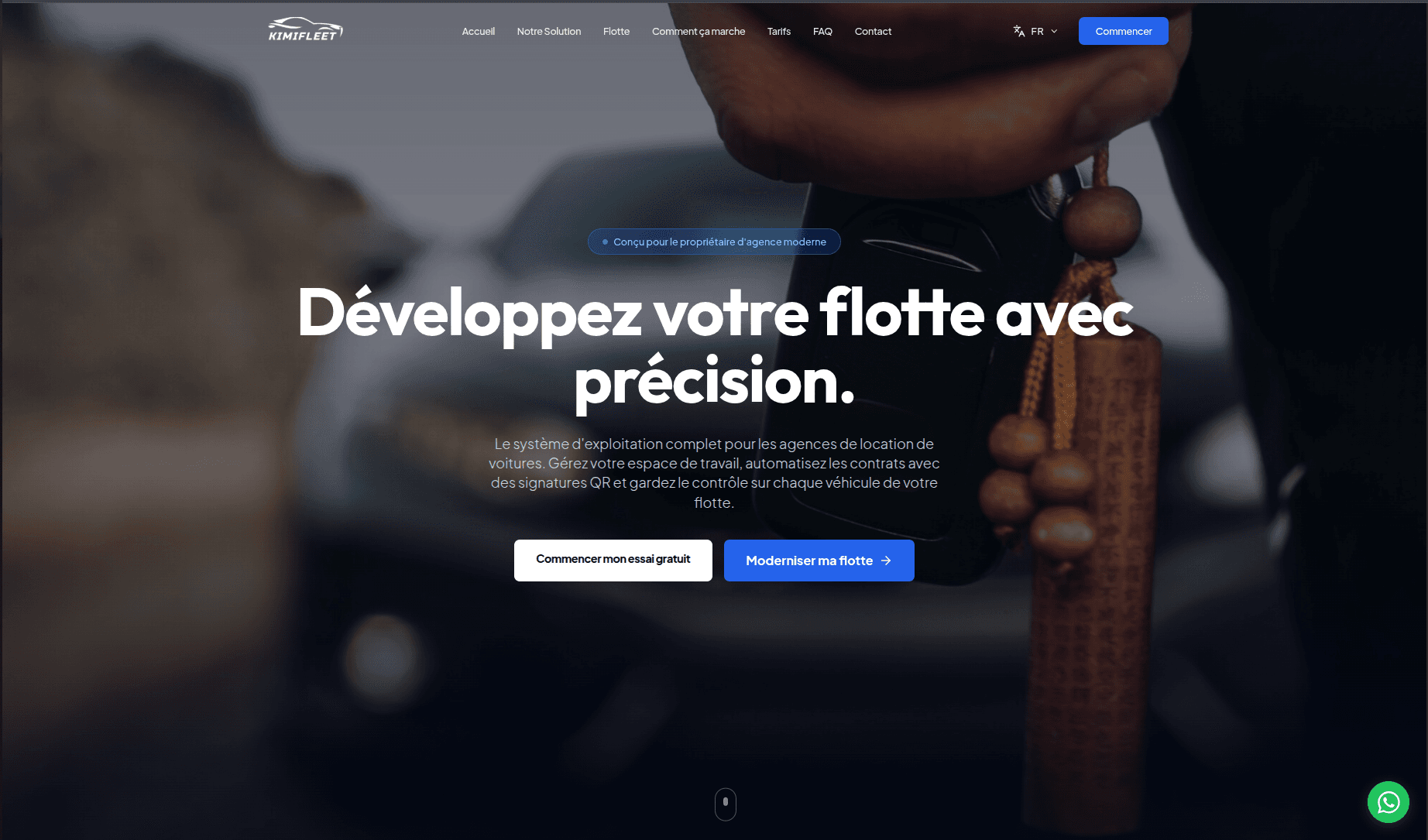
KimiFleet centralizes fleet, rental, client, invoicing, and staff-permission management behind one multi-tenant backend. It serves a rental-agent dashboard, a public booking portal, a marketing site, and a mobile app, built specifically around the Moroccan rental workflow (MAD currency, French/Arabic/English, locally-compliant invoices).
Key features
- Multi-tenancy & security
- Row-level businessId isolation enforced by an application-layer guard, a custom RBAC catalog (fleet/clients/rentals/invoices/maintenance/team/settings × read/write/delete), staff invited via time-limited tokens, JWT access/refresh tokens, and brute-force login lockout.
- Rental lifecycle management
- Bookings move through reserved → active → finished/cancelled with transactional vehicle-status sync and date-range conflict checks, plus CSV export for record-keeping.
- Contract signing (legal/compliance)
- A rental agent generates a short-lived signature session; the client opens the link on their own phone and signs on an HTML canvas built on Pointer Events (mouse, touch, or stylus all work); the dashboard polls for completion and merges the signature into a print-ready A4 invoice with Moroccan tax fields and a VAT-exemption footnote, without a third-party e-signature vendor in the loop.
- Fleet & vehicle profitability
- Per-vehicle net profit (revenue minus logged maintenance cost), an availability calendar, and status tracking (available/reserved/rented/maintenance/out-of-service).
- Notifications & communication
- Real-time in-app notifications over Socket.io, Expo push notifications to mobile, all content localized to French, English, and Arabic.
- Admin/analytics
- A platform-wide dashboard for super-admins (business/user/revenue growth, top-performing businesses) and a per-business dashboard for owners (revenue trend, fleet utilization, collection rate, month-over-month growth), built with Recharts.
- Billing
- Manual per-rental invoicing (pending/paid, full/partial) plus separate subscription billing for the businesses paying to use KimiFleet itself (3- and 6-month plans).
Architecture
- Backend: NestJS + PostgreSQL/Prisma (18 models, 34 migrations, 26 feature modules, 100+ REST endpoints). A typed, modular structure supports tenant-facing features without turning into a monolith of ad-hoc scripts.
- Multi-tenancy: row-level businessId plus an application-layer guard rather than schema-per-tenant, which is simpler operationally for a single-database SaaS at this stage. The public booking portal uses subdomain-per-tenant routing (<slug>.kimifleet.com), with Nginx injecting a business-identifying header that the API resolves per request.
- Redis + BullMQ: recurring jobs (maintenance checks, rental start/expiry transitions, rental-ending digests, subscription reminders) run as durable, retryable queue jobs instead of in-process cron, so scheduled work survives restarts and deploys. Redis also backs rate-limiting, login-lockout counters, and short-lived session state for the OTP and e-signature flows.
- File storage: Cloudflare R2 (S3-compatible), with presigned URLs for private files and a CDN-backed public bucket.
- Real-time: a single Socket.io gateway, per-user rooms, purely for notifications.
- Frontend: React 19 + Vite for the dashboard and client portal, Expo/React Native for mobile. Five separate applications share one backend.
- CI/CD: each application has its own GitHub Actions pipeline that builds and pushes a Docker image to GHCR, then fires a repository_dispatch event to a dedicated infrastructure repo, which deploys via SSH to a Dockerized host behind Nginx.
Decisions and trade-offs
- Cross-device contract signing without a paid e-sign vendor: getting a client to sign on their own phone, not the rental agent's screen, meant building a handoff: a Redis-backed session token with a short TTL, a canvas signature pad that works across input types, and a polling loop on the dashboard that picks up the completed signature and attaches it to the rental automatically.
- Vehicle-level profitability instead of fleet-level totals: revenue and maintenance cost live in separate tables (rentals vs. maintenance records); getting an accurate profit/loss number per vehicle meant aggregating both per-vehicle rather than just totaling fleet-wide numbers, which is what most tools stop at.
- Tenant isolation without schema-per-tenant complexity: chose row-level isolation plus an application guard over separate schemas or databases per tenant, keeping operations simple for a single-founder team, while still giving each business its own portal-like subdomain via Nginx header injection.
Stack
- React 19
- Vite
- NestJS
- TypeScript
- PostgreSQL
- Prisma
- Redis
- BullMQ
- Socket.io
- Expo
- React Native
- Cloudflare R2
- Docker
- GitHub Actions
- Nginx
- JWT
Where it stands
Live in production at kimifleet.com. Built solo over roughly 4 months, from initial architecture to deployment. The platform is fully operational, but no businesses have registered yet. It is pre-customer rather than pre-launch technically.